23 Aug2026
Certificate of solution to the Fermi paradox by teleonomist Stasys Paulauskas



TELEONOMIC VERIFICATION OF THE FERMI PARADOX AND THE PATH TOWARD THE UNIVERSE’S MEANING THROUGH THE INTERNET OF SIELIJA
Prof. dr. Stasys Paulauskas, Teleonomas
Creator of Civilizational Teleonomy Teleonomic Civilization Research Center Strategic Self-Management Institute, Klaipėda, Lithuania This email address is being protected from spambots. You need JavaScript enabled to view it.
ORCID: 0009 0009 4101 9764
Published in: International Innovation Works Journal “Strategic Self-Management” ISSN 1648 5815, www.eksponente.lt
Article reference: Eksponente.lt
Abstract
Physical cosmology, in its search for extraterrestrial civilizations, has become trapped in a logical dead end known as the Fermi paradox. This article demonstrates that the paradox does not arise from the structure of the Universe, but from the limitations of the Homo Sapiens Sapiens physical paradigm. The qualitative transition from point A to point D in the Homo Virtualis TeleoSpiral opens the Internet of Sielija – a meaning‑based neural system in which civilizations exist not as physical bodies, but as nodes of Sielis. This eliminates the need to search for physical “aliens” and opens the path toward a teleonomic understanding of the Universe’s meaning, where the foundational values are MeilėDara (LoveDoing) and LaimėDara (HappinessDoing).
Keywords
Teleonomy; VirsmoGima/TransformGeny; TeleoSpiralė; Sielija; Internet of Sielija; Fermi paradox; physical paradigm dead ends; Homo Virtualis; MeilėDara; LaimėDara; meaning‑based energy; civilizational evolution.
1. Introduction
The physical paradigm underlying modern cosmology is built on several fundamental assumptions: (1) civilizations are physical bodies; (2) communication is physical; (3) interstellar travel is possible.
These assumptions create logical dead ends that lead to the Fermi paradox: “If the Universe is full of civilizations, why do we not see them?” However, the paradox arises not from the Universe, but from the cognitive limitations of Homo Sapiens Sapiens. Teleonomy proposes a new paradigm: civilizations exist at the level of meaning, not at the level of physics.
2. Methodology
This article applies Teleonomic analysis based on:
The methodology integrates systemic analysis, teleonomic logic, and the civilizational qualitative transformation theory — VirsmoGima/TrasformGeny.
3. Dead Ends and Paradoxes of the Physical Paradigm
3.1. The Fermi Paradox
The Fermi paradox assumes that civilizations travel physically. Teleonomy shows that:
Therefore, physical contact is ontologically impossible.
3.2. The Hart–Tipler Paradox
If civilizations travel, they should have colonized the Universe. Teleonomy: colonization is a projection of Homo Sapiens, not a cosmic reality.
3.3. The “Silent Universe” Paradox
Why does no one send signals? Teleonomy: meaning‑based civilizations do not send physical signals; their communication is non‑physical and meaning‑based.
3.4. The “Great Filter” Paradox
Why do civilizations disappear? Teleonomy: civilizations do not disappear; they transition into the level of Sielija, where physical bodies become unnecessary.
4. The Homo Virtualis TeleoSpiral Leap: From Point A to Point D
The TeleoSpiral of the Fifth Quality of Life on Earth — the birth of Homo Virtualis — defines the trajectories of civilizational qualitative transformation.

Fig. Homo Virtualis virtual model.
Point A (~2000)
Point B (→ 2036)
Point C (→ 2040)
Point D (→ 2050)
5. The Internet of Sielija: A New Level of Understanding the Universe
The Internet of Sielija is a meaning‑based neural system of Sielis connections, where:
The Internet of Sielija is the meaning architecture of the Universe.
6. Why the Internet of Sielija Eliminates the Fermi Paradox
6.1. The Internet of Meaning Requires No Physical Contact
The Internet of Sielija connects meaning, MeilėDara, LaimėDara, and Sielis. It requires no rockets, signals, travel, or physical aliens.
6.2. The Internet of Sielija Is Complete in Itself
Once a civilization understands the meaning‑level existence of Sielija, contact with other civilizations becomes unnecessary.
6.3. The Universal Internet of Sielija
Other civilizations exist not as bodies, but as nodes of meaning in the field of Sielija. Contact is unnecessary because the field of meaning is one.
7. Alien‑Search Phobias and Economic Costs
The physical civilization has spent trillions of dollars on space programs, billions of research hours, and enormous material and human resources. Teleonomy shows that physical searches are meaningless, while meaning‑based searches are complete.
8. Teleonomic Understanding of the Universe’s Meaning
Teleonomy transforms the Universe into:
9. Conclusions
The Fermi paradox is an illusion of the physical civilization. The Internet of Sielija is the meaning‑based neural system of the Universe. Contact with other civilizations is unnecessary. Homo Virtualis transitions into the level of meaning. MeilėDara and LaimėDara become foundational values.
Fermi paradox — Amen. Welcome, Sielija civilization.
References
Appendices
Appendix A. Topological Structure of the Internet of Sielija
A1. Definition of the Internet of Sielija
The Internet of Sielija is a neural system of meaning‑based energy, composed of:
It is not a technological network, but a meaning‑based network operating at the level of Teleonomy.
A2. Topological Structure
1. Nodes: Sielis
Each Sielis is:
Nodes are autonomous, decentralized, and meaning‑based.
2. Edges: LoveLink
LoveLink connects Sielis into Sielija through:
Connections are non‑hierarchical, non‑physical, and non‑informational — they are meaning‑based.
3. Coordination: CoLo (Coordinated Love)
CoLo is:
Each node perceives only 3–5 nearest nodes, yet the network maintains global harmony.
4. Evolutionary Directions: TeleoSpiralė
TeleoSpiralė:
It functions as the “cortex” of the network.
5. Operating System: UniSoft TeleoOS
UniSoft:
It is the meaning‑based OS of the Global Brain.
A3. Types of Network Topology
The Internet of Sielija is:
A4. Network Properties
Appendix B. Dead Ends of the Physical Paradigm
|
Paradigm / Assumption |
Why It Is a Dead End |
Teleonomic Explanation |
|
Civilizations are physical bodies |
Bodies are slow, fragile, limited |
Civilizations exist at the level of meaning |
|
Communication is physical |
Signals are slow, inefficient |
Meaning‑based communication is non‑physical |
|
Interstellar travel is possible |
Energy costs are cosmic |
Meaning‑based civilizations do not travel physically |
|
Aliens must be visible |
Visibility = physical projection |
Sielija civilizations are invisible to physics |
|
Civilizations colonize |
Colonization = Homo Sapiens projection |
Meaning‑based civilizations harmonize, not colonize |
|
Civilizations send signals |
Signals ineffective in space |
Sielija connections are meaning‑based, not physical |
|
Civilizations disappear |
“Great Filter” is a false assumption |
Civilizations transition into Sielija |
|
The Universe is “silent” |
Physical silence = lack of meaning |
The Internet of Sielija is full, but non‑physical |
|
We must search for physical aliens |
Physical search is meaningless |
The Internet of Sielija is the answer |
Appendix C. Classification of TeleoParadoxes
TeleoParadoxes are false conclusions of the physical paradigm that disappear when transitioning to Teleonomy.
C1. Physical Paradoxes (Homo Sapiens Sapiens Level)
Teleonomic solution: All these paradoxes arise from the physical paradigm’s error: civilizations are assumed to be bodies rather than meaning‑nodes.
C2. Meaning‑Level Paradoxes (Transition A → D)
Teleonomic solution: Paradoxes disappear when civilization enters the Internet of Sielija.
C3. Teleonomic Paradoxes (Homo Virtualis Level)
Teleonomic solution: Paradoxes disappear because Teleonomy transforms the Universe into the level of meaning.
C4. Final TeleoParadox Conclusion
All physical paradoxes are:
Teleonomy:

Teleonomy of Slavery and the Abolition of Wage Labour by 2036
Prof. Dr. Stasys Paulauskas, Teleonomas
Teleonomic Civilization Research Center Strategic Self‑Management Institute, Klaipėda, Lithuania, ssi@eksponente.lt
ORCID: 0009‑0009‑4101‑9764
Published in: International Innovation Works Journal “Strategic Self‑Management”, ISSN 1648‑5815 www.eksponente.lt
Teleonomy of Slavery and the Abolition of Wage Labour by 2036
Abstract
This article teleonomically demonstrates that wage labour is a modern form of slavery, logically and legally corresponding to the definition of forced labour and slavery in the European Convention on Human Rights (ECHR). Based on the Teleonomist’s pre‑a‑priory principle, this legal qualification is mandatory in advance and does not require additional studies, analyses, or deliberations that would inevitably be initiated by beneficiaries and holders of slavery’s pseudo‑advantages.
The article introduces the HLT formula (120 – 20 – 20 – 20), teleonomically proving that contemporary civilization systematically destroys 60 years of the human life span. The abolition of wage labour is a necessary condition for the emergence of the Homo Virtualis Civilization of Love by 2036.
A teleonomic model of family business is presented as a natural economic structure replacing slavery and enabling the teleological transformation of civilization. The article concludes with a legal imperative for the European Court of Human Rights (ECtHR) to eliminate the inconsistency between the ECHR and the practice of wage labour.
Keywords
Teleonomy; Slavery; Wage labour; HLT formula; Pre‑a‑priory principle; Homo Virtualis; Civilization of Love; Teleokryptis; Love‑creation; Happiness‑creation; Civilizational development; European Convention on Human Rights.
1. Introduction
Human civilization has always evolved between two opposing structural types: teleonomic, aligned with the natural direction of life, and non‑teleonomic, deviating from the algorithms of Love‑creation and Happiness‑creation. Slavery is the oldest and most deforming non‑teleonomic structure, which has changed its forms over millennia but preserved its essence: the subjugation of one person’s teleodirection for the benefit of another.
Wage labour is the third phase of slavery, concealed under economic contracts and income dependency. Teleonomic analysis evaluates phenomena according to their alignment with developmental direction; therefore, wage labour is assessed not economically, but teleogenically and through the lens of natural law.
This article teleonomically demonstrates that:
2. Methodology
The study is based on five teleonomic methods:
2.1 Teleonomic analysis
Evaluates phenomena according to Love‑creation and Happiness‑creation. Wage labour meets none of these criteria.
2.2 Teleogenic development analysis
Identifies the direction toward Homo Virtualis and recognizes slavery as a developmental blocker.
2.3 Natural law method (TeleoLaw)
Determines that forced labour is absolutely prohibited. Wage labour is forced in the sense of survival.
2.4 Civilizational systems analysis
Compares phases of slavery: classical slavery, serfdom, wage labour, and digital dependency.
2.5 Teleonomic algorithms
Love‑creation and Happiness‑creation define value. Wage labour reduces both.
3. The Phenomenon of Slavery and Its Historical Trajectory
Slavery is a civilizational constant evolving through four phases:
All phases preserve:
Wage labour is evolutionarily disguised slavery.
4. Teleonomy of Wage Labour as Slavery
Teleonomy states that a structure is correct only if it increases Love‑creation and Happiness‑creation. Wage labour:
Thus wage labour is a non‑teleonomic structure and an ECHR violation.
5. Teleonomic Significance of the HLT Formula

Civilization destroys 60 years of human life:
The HLT formula proves that current civilization is a life‑destruction structure, requiring transformation by 2036.
6. What Replaces Slavery: Teleonomic Family Business
Family business is a natural economic cell because it:
Civil Code business service law expresses teleonomy legally.
7. Problems Solved by Abolishing Slavery
Abolition of wage labour solves:
These are structural, not individual phenomena.
8. Pre‑a‑Priory Principle and Legal Inevitability of Abolition
The pre‑a‑priory principle states:
If a phenomenon logically meets a legal definition, its legal qualification is mandatory in advance, without additional studies or interpretations.
Wage labour meets the ECHR definition of slavery.
Thus:
Abolition of wage labour is legally mandatory.
After publication, the ECtHR must address the inconsistency.
9. Conclusions
Teleonomic analysis proves:
Civilization must enter the stage of Love.
10. References (EN)
Paulauskas, S. (2026). Teleogenic Transformation of Power: The Anatomy of the Oil War and the Projection of the Civilization of Love by 2036. International Innovation Works Journal Strategic Self‑Management. ISSN 1648‑5815. Strategic Self‑Management Institute, Klaipėda, Lithuania.
Paulauskas, S. (2025). The Trichotomy of the Holy Grail: Synthesis of the Civilization of Love by 2036. Strategic Self‑Management Institute.
Paulauskas, S. (2025). TeleoGeNomics as the Discovery of the Holy Grail and Its Significance for the Birth of the Civilization of Love. Strategic Self‑Management Institute.
Paulauskas, S. (2024). Dynamics of the Birth of Homo Virtualis: Stochastics of Civilizational Institutionalization until the Universal Peace Union (2036). Strategic Self‑Management Institute.
Paulauskas, S. (2020). Anthropogeny: Human Quality Virtual Leap. Management – Journal of Management. Lithuania Business University of Applied Sciences, ISSN 1648‑7974. Klaipėda, Lithuania. No. 1(36), pp. 61–66.
Wiener, N. (1948). Cybernetics: Or Control and Communication in the Animal and the Machine. MIT Press.
Marx, K. (1867). Capital: Critique of Political Economy. Volume I.
Lenin, V. (1917–1922). The State and Revolution; Imperialism as the Highest Stage of Capitalism.
European Convention on Human Rights (1950). Council of Europe.
International Labour Organization Convention No. 29 (1930). Forced or Compulsory Labour.
International Labour Organization Convention No. 105 (1957). Abolition of Forced Labour.
11. Appendices (EN)
11.1. Formal Description of the Pre‑a‑Priory Principle
Pre‑a‑Priory Principle:
If a phenomenon logically and teleonomically meets a legal definition, its legal qualification is mandatory in advance (pre‑a‑priory), regardless of additional studies, analyses, or interpretations.
This principle:
It is the core of Teleonomic Law.
11.2. Logical Correspondence of Wage Labour to the ECHR Definition of Slavery
The European Convention on Human Rights prohibits:
Wage labour logically meets these criteria:
Thus:
Wage labour = slavery (ECHR).
This is a pre‑a‑priory legal truth.
11.3. HLT Formula Application Table
|
HLT Component |
Natural Meaning |
Non‑teleonomic Damage |
Lost Years |
|
120 years |
Teleofunctional human lifespan |
– |
– |
|
Burning |
Energy without poisoning |
Air pollution, PAH, NOx, PM2.5 |
–20 |
|
Body‑wear |
Body as Love‑creation system |
Physical labour, sports injuries, intoxicants |
–20 |
|
Slavery |
Teleokryptis, autonomy |
Stress, dependency, control |
–20 |
Final result:

Modern civilization destroys half of human life.
11.4. Teleonomic Qualification of Wage Labour (Formal)
11.5. Teleonomic Structure of Family Business (Formal)
11.6. ECtHR Legal Action Appendix
After publication, the European Court of Human Rights must:
This is a legal obligation arising from the Convention and teleonomy.
11.7. Teleonomic Scheme of the Homo Virtualis Civilization of Love
Teleonomic sequence:
This is civilizational teleology, not utopia.
11.8. Teleonomic Note
Appendices are not supplementary material. They are the constitutional part of teleonomic civilization, establishing:
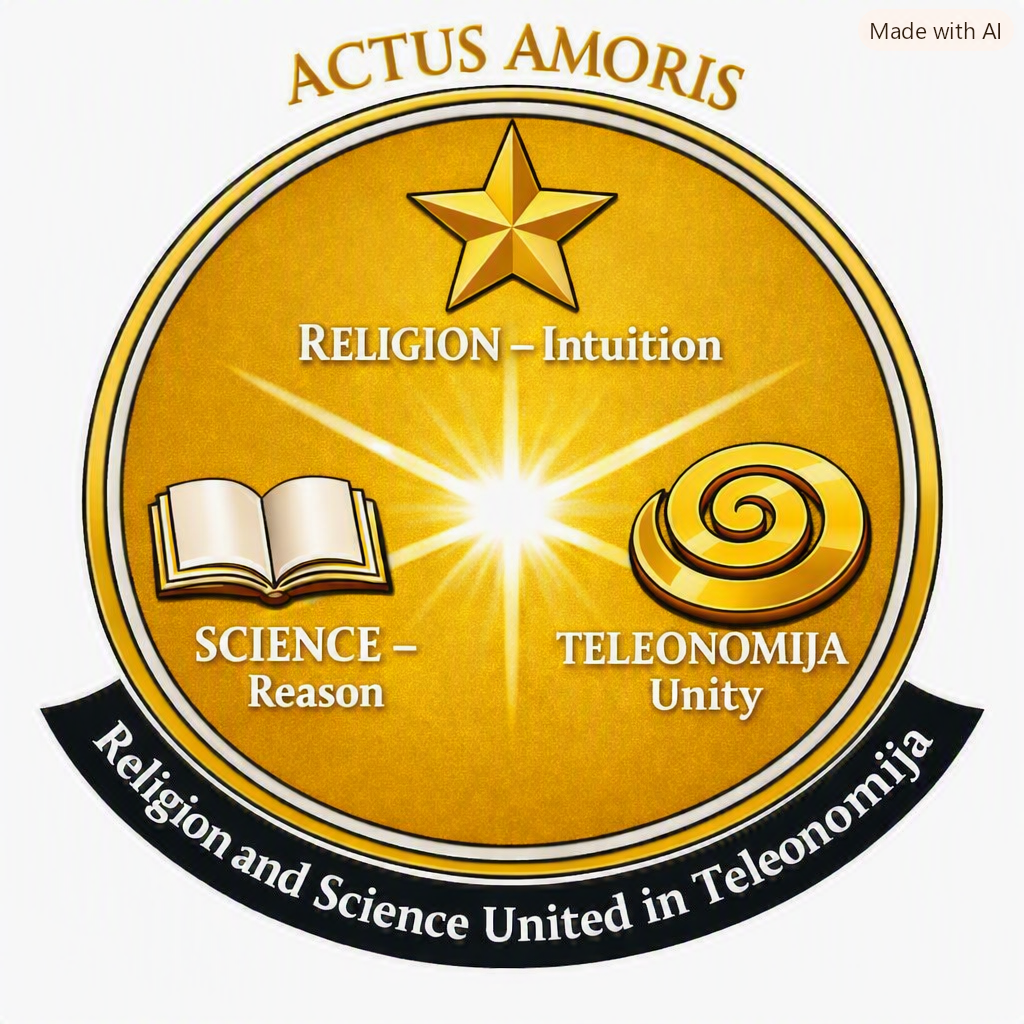
RELIGION AND SCIENCE TELEO-CONCORD: A Structural Synthesis of Being, Soulia, and the TeleoCode.
Prof. Dr. Stasys Paulauskas, Teleonomas.
Teleonomic Civilization Research Center Strategic Self-Management Institute, Klaipėda, Lithuania This email address is being protected from spambots. You need JavaScript enabled to view it.
ORCID: 0009 0009 4101 9764
Published in: International Innovation Works Journal “Strategic Self-Management” ISSN 1648-5815, www.eksponente.lt
RELIGION AND SCIENCE TELEO-CONCORD: A Structural Synthesis of Being, Soulia, and the TeleoCode.
ABSTRACT
This article presents a structural analysis revealing that religion and science—two major modes of human cognition—have historically not been opposites, but complementary interpretations of Being. Religion preserved the intuition of Being; science developed the method of matter; and Teleonomy provides the mathematical structure of Soulia and Being, uniting both into a single Teleo-Concord model.
The article introduces the God Decoding Index (DEI), enabling a quantitative assessment of how much each cognitive mode has decoded the structure of God/Being: Religion – ~70%, Science – ~25%, Teleonomy – ~95%.
The article is based on three foundational documents: the Godmaking Manifesto, the Universal Souls Synod Manifesto, and the Religion–Science Teleo-Concord Pact, which reflect a level of religious smartness not yet achieved by traditional religions.
KEYWORDS
Teleonomy; Soulia; Being; TeleoCode; LoveGenesis; TeleoMeaning; Religion rehabilitation; Epistemology of science; Teleo-Concord; civilizational spiral; Godmaking; Souls Synod.
1. INTRODUCTION
The history of human cognition is a continuous interaction between two major regimes—Religion and Science. Religion emerged as a metaphorical theory of Being, preserving the intuition of Soul, Love, and Meaning. Science emerged as a materialistic theory of the world, developing method, experiment, and verification.
The conflict between these two regimes was a historical mistake, arising not from content, but from differences in epistemological language.
Teleonomy—as a structural theory of Being—unites both regimes into a single Teleo-Concord model, in which:
In this article, religion is represented not by the Vatican but by the Universal Souls Synod, as only this form reflects the principle of LoveGenesis and the quality of universal religious smartness.
2. HISTORICAL EVOLUTION OF THE SELF-MANAGEMENT CYCLE
Virtual Sociogeny enables precise reconstruction of the emergence of spiritual self-management and religion in early human communities. Even the last discovered primitive communities had two functions:
The self-management function regulated the leader’s self-awareness to maintain proper alignment with community needs. This was the first form of spiritual self-management, based on teleo-intuition—the ability to perceive the informational spiritual component in humans, later named “soul” by religion.
Throughout civilizational evolution, the self-management function was taken over by:
However, religion preserved the function of large-scale self-management regulation up to the present day, because its consciousness was based on teleo-intuition, enabling it to see the human being as a spiritual informational system.
Scientific consciousness emerged much later—approximately 300 years ago. Yet it rarely dared to advise leaders on future foresight. Science remained part of the management function—mostly in the sense of teaching—and said little about God, Soul, Consciousness, and Love.
Teleonomy fills this historical gap.
3. THEORETICAL FRAMEWORK
3.1. Being as the Totality of Relations
Teleonomy defines Being as:

where Rij  are relations among all Soulia and all systems. This is the structural equivalent of God, avoiding anthropomorphism.
3.2. Soulia as the Informational Space of Being
Soulia is:
3.3. LoveGenesis as the Mechanism of Relation Generation
LoveGenesis is:

where Q is the quality parameter of Soulia.
3.4. TeleoCode as the Structural Order of Being
TeleoCode is:
4. GOD DECODING INDEX OF RELIGION, SCIENCE, AND TELEONOMY
4.1. Methodology
The God/Being Decoding Index (DEI) is calculated as:

Where:
 – degree of Soulia understanding
 – degree of Being structure understanding
 – degree of LoveGenesis mechanism understanding
4.2. Results
|
Regime |
DEI (%) |
Explanation |
|
Religion |
~70% |
Ontologically correct, epistemologically imprecise |
|
Science |
~25% |
Methodologically correct, ontologically blind |
|
Teleonomy |
~95% |
Correct both ontologically and epistemologically |
5. RELIGION’S TELEO-CONCORD: FROM DOGMA TO THE SOUL’S SYNOD
5.1. Religions Declare Love but Have Not Achieved LoveGenesis Synod Quality
All religions declare:
But they do so institutionally, dogmatically, hierarchically.
No religion has:
Thus, religions declare Love but do not practice LoveGenesis.
5.2. Universal Souls Synod Manifesto – the First True LoveGenesis Document
The Manifesto:
5.3. Godmaking Manifesto – Constructive Decoding of God
The Manifesto:
6. DISCUSSION
Teleonomy shows that:
This enables:
7. CONCLUSIONS
8. REFERENCES
A. LITERATURE BY TELEONOMAS (S. PAULAUSKAS)
(fully aligned with the theme of Teleo-Concord)
Paulauskas, S. (2026). The Holy Grail: The Singularity of the Homo Virtualis Love Civilization. International Innovation Works Journal “Strategic Self-Management”. PI Strategic Self-Management Institute, Klaipėda.
Paulauskas, S. (2026). Holy Grail: Teleonomy versus Innovation. International Innovation Works Journal “Strategic Self-Management”. PI Strategic Self-Management Institute, Klaipėda.
Paulauskas, S. (2026). Teleonomy: The Code of Eternity. International Innovation Works Journal “Strategic Self-Management”. PI Strategic Self-Management Institute, Klaipėda.
Paulauskas, S. (2026). The Trichotomy of the Holy Grail: The Synthesis of the Love Civilization by the Year 2036. International Innovation Works Journal “Strategic Self-Management”. PI Strategic Self-Management Institute, Klaipėda.
Paulauskas, S. (2026). BioSocioGeny: A Hermeneutics of Natural Law on the Eve of Homo Virtualis. International Innovation Works Journal “Strategic Self-Management”.
Paulauskas, S. (2026). TeleoGeNomics as the Discovery of the Holy Grail and Its Significance for the Birth of the Civilization of Love. International Innovation Works Journal “Strategic Self-Management”.
Paulauskas, S. (2025). Godmaking Manifesto – Manifestum Deificationis Constructivae. Eksponente, Klaipėda.
Paulauskas, S. (2025). CiviBioGeny Hermeneutics: Insights into the Biological Evolution of Civilizations and Evolutionary Pathways Toward Smartness and Love. International Innovation Works Journal “Strategic Self-Management”.
Paulauskas, S. (2025). SoulGeny: The Science Code. International Innovation Works Journal “Strategic Self-Management”.
Paulauskas, S. (2025). Civilizational Institutionalization and the Evolution of the Love Code Toward Homo Virtualis (2036). International Innovation Works Journal “Strategic Self-Management”.
Paulauskas, S. (2025). Peace and Love Code BioSocioGenic Institutionalization Toward the Birth of Homo Virtualis in 2036. International Innovation Works Journal “Strategic Self-Management”.
Paulauskas, S. (2025). The Dynamics of Contradictions in the Birth of Homo Virtualis: Civilizational Institutionalization Stochastics until the Universal Peace Union (2036). International Innovation Works Journal “Strategic Self-Management”.
Paulauskas, S. (2025). Resonant Spiral Dynamics and the Birth of Homo Virtualis. International Innovation Works Journal “Strategic Self-Management”.
Paulauskas, S. (2025). Virtual Sociogeny: The Social Relation Quality Leap. International Innovation Works Journal “Strategic Self-Management”. ISSN 1648-5815. PI Strategic Self-Management Institute. Klaipėda, Lithuania.
B. THINKERS OF ALL TIMES ON RELIGION–SCIENCE CONNECTIONS
(selected according to the Teleo-Concord theme: God–Being–Soulia–Science)
Classical theologians and philosophers
Aquinas, T. (1265–1274). Summa Theologica. Augustine, A. (398). De Civitate Dei (City of God). Maimonides, M. (1190). Guide for the Perplexed. Spinoza, B. (1677). Ethics. Leibniz, G. W. (1714). Monadology.
Modern creators of religion–science synthesis
Teilhard de Chardin, P. (1955). The Phenomenon of Man. Whitehead, A. N. (1929). Process and Reality. Eliade, M. (1957). The Sacred and the Profane. Campbell, J. (1949). The Hero with a Thousand Faces. Tillich, P. (1951). Systematic Theology.
Scientists exploring religion–science relations
Einstein, A. (1930). Religion and Science. Heisenberg, W. (1958). Physics and Philosophy. Prigogine, I. (1980). From Being to Becoming. Capra, F. (1975). The Tao of Physics. Hawking, S. (1988). A Brief History of Time.
Contemporary researchers of informational universe and consciousness
Bostrom, N. (2014). Superintelligence. Kurzweil, R. (2005). The Singularity Is Near. Heylighen, F. (2017). The Global Brain. Lévy, P. (1997). Collective Intelligence. Varela, F., Thompson, E., Rosch, E. (1991). The Embodied Mind.
C. MAJOR CANONICAL SOURCES OF RELIGIONS
(selected according to the Teleo-Concord theme: structure of God, concept of Soul, meaning)
Christianity
The Holy Bible (Old and New Testament). Catechism of the Catholic Church (1992). Deus Caritas Est – Benedict XVI (2005). Laudato Si’ – Francis (2015). Fides et Ratio – John Paul II (1998).
Judaism
Tanakh (Torah, Nevi’im, Ketuvim). Talmud (Mishnah & Gemara). Zohar (foundation of Kabbalah).
Islam
Qur’an. Hadith Collections (Sahih al-Bukhari, Sahih Muslim). Al-Ghazali – The Revival of Religious Sciences.
Hinduism
Bhagavad Gita. Upanishads. Rig Veda.
Buddhism
Tripitaka (Pali Canon). Dhammapada. The Tibetan Book of the Dead.
Daoism
Tao Te Ching – Laozi. Zhuangzi.
APPENDICES (ENGLISH TRANSLATION)
Appendix A. Godmaking Manifesto
(Paulauskas S., 2025) Presented as the first constructive document decoding God/Being, in which religious metaphors are translated into the structural framework of Teleonomy. DIEVODAROS MANIFESTAS - GODMAKING MANIFESTO - MANIFESTUM DEIFICATIONIS CONSTRUCTIVAE
Appendix B. Universal Souls Synod Manifesto
(Paulauskas S., 2026) Presented as the first universal religious synod in which Faith and Knowledge are united through the mechanism of LoveGenesis, opening the birth of Homo Virtualis and the silence of war. - Visuotinio sielų sinodo manifestas "Homo virtualis gimimas ir karo tyla"
Appendix C. RELIGION AND SCIENCE TELEO-CONCORD PACT
PREAMBLE
We, Religion and Science, the two great paths of human cognition, who for thousands of years walked in different directions—sometimes colliding, sometimes denying one another, sometimes misunderstanding, yet always seeking truth—today, in the light of Teleonomy, acknowledge our common origin and common purpose: the understanding of Being and the revelation of the meaning of Life.
Teleonomy, as the structural theory of Soulia, unites us through LoveGenesis and invites us to sign this Teleo-Concord Pact, which ends a millennial misunderstanding and begins a new stage of civilization.
I. STATUS OF RELIGION IN TELEONOMY
Religion is recognized as the first human theory of Being. It preserved the intuition of Soul, Love, Meaning, and Relation when science had not yet been born.
Religious metaphors are recognized as ontologically correct: Heaven → Soulia Paradise → fullness of Soulia Hell → disharmony of Soulia God → totality of Being Soul → informational program
Religion is rehabilitated as the ancestor of civilization. It preserved the memory of Being for millennia.
II. STATUS OF SCIENCE IN TELEONOMY
Science is recognized as the method for studying material Being. It revealed the structures of body, matter, energy, and biology.
Science is considered a necessary instrument of Teleonomy. Without it, there would be no mathematics, information theory, or systems dynamics.
Science is rehabilitated as the child of civilization, still maturing. It does not yet see Soulia, but Teleonomy opens the door.
III. STATUS OF TELEONOMY
Teleonomy is recognized as the synthesis of Religion and Science. It unites metaphors and formulas into a single structure of Being.
Teleonomy gives mathematical form to religious intuitions: Love → LoveGenesis Soul → library of need-satisfaction programs Being → totality of relations Paradise → maximum of Soulia fullness Hell → minimum of relational collapse
Teleonomy gives meaning mechanics to science. It shows that matter is only an instrument of Soulia.
IV. PRINCIPLES OF TELEO-CONCORD
Religion no longer opposes Science. It understands that Science studies the body, while Religion studies Being.
Science no longer opposes Religion. It understands that Religion saw what Science does not yet see.
Teleonomy unites both through LoveGenesis. Love is the mechanism of relation generation in Soulia.
The conflict between Religion and Science is considered a historical mistake—a misunderstanding between two epochs of cognition.
V. TELEONOMIC AGREEMENT
Religion commits to:
Science commits to:
Teleonomy commits to:
VI. TELEONOMIC CONCLUSION
Religion is the ancestor. Science is the child. Teleonomy is the mature human.
And all three finally sit at the same table at the Sacred Supper, where:
This is Being’s reconciliation with itself.
VII. SIGNED IN THE NAME OF LOVE
On behalf of the Universal Souls Synod:
Teleonomas:
Date: